Does Teeth Whitening Damage Tooth Enamel? 5 Common Misconceptions
One of the most common concerns among people who want a brighter, more attractive smile is: does teeth whitening damage enamel? Conflicting information online, especially claims that bleaching can wear down or thin the enamel, can make patients hesitant about treatment.
So, does teeth whitening damage enamel?
When professional teeth whitening is carried out under the supervision of a dentist, using an appropriate product, concentration and application time after evaluating the patient’s oral health, there is no strong scientific evidence showing that it causes clinically significant permanent enamel damage.
However, every patient is different. Existing cavities, gum problems, tooth sensitivity, cracks and dental restorations should be assessed before whitening treatment.
What Is Professional Teeth Whitening?
Teeth whitening, also known as dental bleaching, is a cosmetic dental procedure designed to reduce discoloration that develops in natural teeth over time and make the tooth shade appear lighter.
Professional whitening systems commonly use bleaching agents containing hydrogen peroxide or carbamide peroxide.
These substances do not work by scraping or mechanically removing the tooth surface. Instead, they chemically interact with the molecules responsible for discoloration and help make the teeth appear lighter.
Understanding this mechanism is important when answering the question does teeth whitening damage enamel?
You can learn more about the professional Teeth Whitening treatments available at ON7 Dental Clinic, including how the procedure is planned and which patients may be suitable candidates.
Does Teeth Whitening Damage Enamel?
From a scientific perspective, the question does teeth whitening damage enamel should be evaluated by considering the concentration of the bleaching agent, contact time and the patient’s existing oral health.
A 2026 systematic review and meta-analysis published in the Journal of Dentistry evaluated the effects of peroxide-based bleaching on enamel. Although small changes in enamel microhardness may be observed under laboratory conditions, the available evidence did not demonstrate strong evidence of clinically meaningful enamel damage when whitening is used according to recommended protocols.
You can review the study through PubMed: Enamel Damage from Tooth-Whitening: A Systematic Review and Meta-Analysis.
This is also why using a higher peroxide concentration or leaving a whitening product on the teeth for longer does not automatically mean better results.
One of the main advantages of professional whitening is that the treatment protocol can be adjusted according to the patient’s teeth, gums, sensitivity level and overall oral condition.
Can Teeth Whitening Cause Tooth Sensitivity?
Some patients may experience temporary tooth sensitivity after bleaching.
According to the American Dental Association (ADA), temporary tooth sensitivity and gingival irritation are among the most commonly reported side effects associated with vital tooth whitening.
Sensitivity may be felt as a short, sharp sensation when:
- drinking cold beverages,
- eating hot or cold foods,
- breathing in cold air.
This should not automatically be interpreted as evidence that teeth whitening has permanently damaged the enamel.
Temporary sensitivity and permanent enamel damage are not the same condition.
If sensitivity becomes severe, persists for an extended period or occurs spontaneously, a dental examination is recommended.
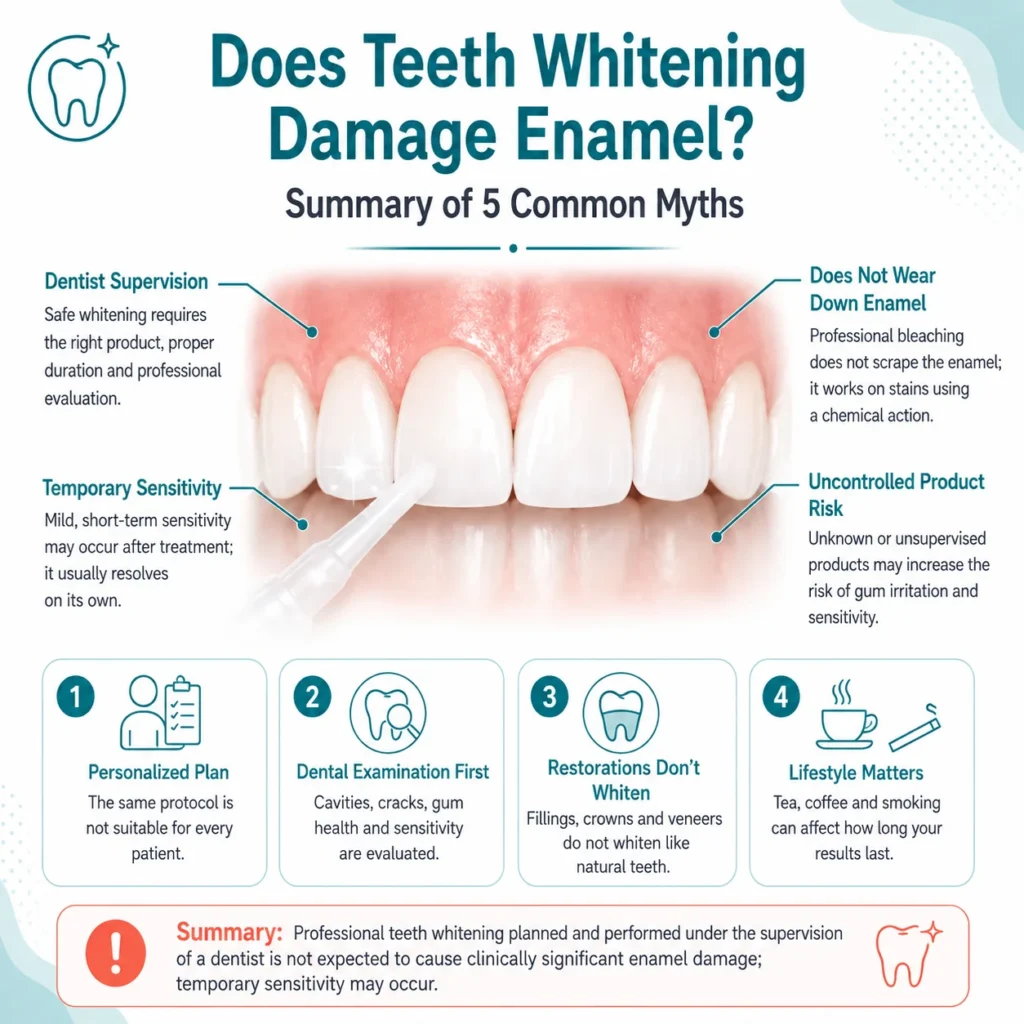
5 Common Myths About Teeth Whitening
A major reason patients continue to ask does teeth whitening damage enamel is that professional whitening treatments are often confused with uncontrolled DIY whitening methods.
Here are five of the most common misconceptions.
Myth 1: Teeth Whitening Wears Away and Thins Enamel
Fact: Professional bleaching is not designed to sand, scrape or mechanically remove enamel.
Peroxide-based whitening agents work chemically on molecules associated with discoloration.
Professional teeth whitening should therefore be distinguished from abrasive home remedies that may physically affect the tooth surface.
When assessing whether teeth whitening damages enamel, the type of product, concentration, application time and treatment protocol all matter.
Myth 2: Every Whitening Product Sold Online Is Safe
Not all whitening products have the same ingredients, concentration, pH level or instructions for use.
Uncontrolled whitening may contribute to:
- tooth sensitivity,
- gingival irritation,
- uneven whitening,
- irritation of oral tissues.
More importantly, an over-the-counter product cannot determine whether you have an untreated cavity, cracked tooth, exposed dentin or gum disease.
In a clinical setting, oral and dental health is evaluated before whitening treatment begins.
At ON7 Dental Clinic, our Cosmetic Dentistry approach considers the condition of the teeth, gums, existing restorations and individual aesthetic expectations before planning treatment.
Myth 3: Sensitivity After Teeth Whitening Is Permanent
Fact: Sensitivity after teeth whitening is temporary for many patients.
Its severity may vary depending on factors such as:
- existing tooth sensitivity,
- peroxide concentration,
- application time,
- individual tooth structure.
Therefore, experiencing temporary sensitivity does not mean that the answer to does teeth whitening damage enamel is automatically yes.
For additional scientific information about whitening-related sensitivity, see the American Dental Association’s Tooth Whitening guidance.
Myth 4: Teeth Whitening Lasts Forever
Fact: Teeth whitening is not permanent.
Over time, natural teeth may become discolored again.
Factors that may contribute to new staining include:
- coffee,
- tea,
- smoking and tobacco products,
- strongly pigmented foods and beverages.
Good oral hygiene and regular dental care may help maintain the achieved shade for longer.
Depending on the patient, maintenance whitening may also be considered later after professional evaluation.
Myth 5: Teeth Whitening Always Looks Artificial
Fact: Professional teeth whitening does not produce exactly the same shade in every patient.
The final change in tooth color may be influenced by:
- the original tooth shade,
- enamel characteristics,
- dentin color,
- the cause of discoloration,
- age,
- existing dental restorations.
It is also important to understand that composite fillings, porcelain restorations and zirconia crowns do not whiten in the same way as natural tooth structure.
Patients who want to improve not only tooth color but also tooth shape, alignment, gum appearance and overall smile harmony can also learn more about ON7 Dental Clinic’s Smile Design treatments.
What Is In-Office Teeth Whitening?
In-office teeth whitening is a professional bleaching procedure performed in a dental clinic under the supervision of a dentist.
Before treatment, the dentist evaluates:
- the teeth,
- gum health,
- existing restorations,
- tooth sensitivity,
- the type of discoloration.
If whitening is considered appropriate, a treatment protocol can then be planned according to the patient’s individual needs.
One of the major advantages of in-office whitening is professional control over:
- whitening concentration,
- application time,
- gum protection,
- sensitivity,
- number of sessions.
This level of control is especially important for patients concerned about whether teeth whitening damages enamel.
Is At-Home Teeth Whitening Safe?
Dentist-supervised at-home teeth whitening should not be confused with random whitening products purchased online.
With professionally supervised home whitening, the dentist may determine:
- which whitening product should be used,
- how much product should be applied,
- how long it should remain on the teeth,
- whether custom whitening trays are needed.
Using more whitening gel than recommended or leaving it on the teeth for longer does not necessarily produce a better or faster result.
Instead, excessive or uncontrolled use may increase the risk of tooth sensitivity and soft-tissue irritation.
For this reason, when considering does teeth whitening damage enamel, the way the product is used is just as important as the product itself.
Is It Safe to Whiten Teeth with Baking Soda and Lemon?
Home whitening methods involving lemon, baking soda or similar products should not be considered equivalent to professional teeth whitening.
Lemon and other acidic substances may contribute to dental erosion when repeatedly exposed to tooth enamel.
Aggressive or frequent use of abrasive substances such as baking soda may also contribute to mechanical wear of the tooth surface.
This is why professional bleaching and acidic or abrasive DIY whitening methods should be evaluated separately.
The fact that a substance is described as “natural” does not automatically mean it is safe for enamel.
How to Make Teeth Whitening Safer
If you are considering teeth whitening, several steps can help support a safer and more controlled treatment process:
- Have a dental examination before whitening.
- Do not ignore existing cavities or gum problems.
- Tell your dentist if you already have sensitive teeth.
- Avoid whitening products with unclear ingredients.
- Do not extend the recommended application time on your own.
- Follow your dentist’s post-treatment recommendations.
- Avoid combining multiple whitening products without professional advice.
The goal of safe teeth whitening should not be to achieve the brightest possible shade at any cost.
The goal is to achieve an appropriate improvement in tooth color while taking the health of the teeth and gums into account.
Frequently Asked Questions About Teeth Whitening
Does Teeth Whitening Damage Enamel?
When professional bleaching is carried out using appropriate products, suitable patient selection and controlled application protocols, there is no strong scientific evidence showing clinically meaningful permanent enamel damage.
The 2026 systematic review also reported that peroxide-based bleaching used according to recommended protocols is unlikely to cause clinically meaningful damage to enamel integrity.
You can review the research on PubMed.
However, excessive or uncontrolled whitening may create risks, which is why professional dental evaluation remains important.
How Long Does Teeth Whitening Take?
The duration of teeth whitening varies according to the whitening system, original tooth shade and individual treatment plan.
For some patients, an in-office whitening procedure may be completed within one clinical appointment.
Others may require more than one session or a combination of in-office and dentist-supervised home whitening.
Does Teeth Whitening Hurt?
Teeth whitening is not a surgical procedure, and many patients do not experience significant pain.
However, temporary tooth sensitivity or short episodes of sensitivity may occur during or after treatment.
The degree of sensitivity varies from person to person.
How Long Do Teeth Whitening Results Last?
Whitening results are not permanent.
The duration of the effect depends on lifestyle and oral hygiene habits.
Frequent consumption of coffee, tea and highly pigmented foods, as well as tobacco use, may contribute to faster discoloration.
Regular oral hygiene may help maintain the result for longer.
Do Fillings, Crowns and Veneers Whiten?
No.
Composite fillings, porcelain veneers, crowns and zirconia restorations do not respond to bleaching in the same way as natural tooth enamel.
For patients with restorations in the visible front region, shade compatibility should be evaluated before treatment.
Reliable Scientific Sources on Teeth Whitening
Health-related information should be supported by credible and verifiable scientific sources.
For more information about teeth whitening, bleaching agents and enamel safety, you can review:
- American Dental Association – Whitening: Information about tooth whitening methods, hydrogen peroxide, carbamide peroxide, tooth sensitivity and gingival irritation.
- PubMed – Enamel Damage from Tooth-Whitening: A Systematic Review and Meta-Analysis: A 2026 systematic review and meta-analysis examining the effects of peroxide-based tooth whitening on enamel microhardness and enamel integrity.
These sources help answer does teeth whitening damage enamel using current scientific evidence rather than unsupported whitening claims.
Professional Teeth Whitening at ON7 Dental Clinic
If you are wondering does teeth whitening damage enamel, which whitening method may be suitable for you or whether your teeth are appropriate for bleaching, the most accurate assessment can be made after a dental examination.
At ON7 Dental Clinic, we evaluate your existing tooth shade, teeth and gum health, dental restorations and sensitivity before planning an appropriate whitening approach.
To learn more about professional teeth whitening or to schedule a consultation, you can contact us through the ON7 Dental Clinic Contact page.
ON7 Dental Clinic Contact Information
Phone: +90 533 456 6617
Email: hello@on7clinic.com
Address: Metropol Istanbul, Atatürk Mah. A3 Block No. 17, Floor 0, 34758 Ataşehir / Istanbul, Türkiye

ON7 Dental Clinic Ataşehir’de modern diş hekimliği teknolojilerini ve uzman diş hekimi kadromuzla hastalarımıza güvenli, konforlu ve kaliteli bir tedavi süreci sunuyoruz
Tedaviniz İçin İlgili Hekimlerimiz
Tedavi seçenekleri ve size uygun planlama hakkında bilgi almak için ilgili hekimlerimizi inceleyebilir veya kliniğimizle iletişime geçebilirsiniz.