If you have ever been told, “There is no bone left in your upper jaw, so you cannot get dental implants,” this does not always mean implant therapy is entirely out of the question. Especially when upper posterior teeth were lost years ago, the vertical bone height required to support an implant can diminish. Sinus lifting (sinus floor elevation) comes into play precisely at this stage to regenerate the necessary osseous space for implants.
The mere presence of the word “sinus” in the name often causes patients more anxiety than the actual surgery itself. Questions like “Will my sinus be damaged?”, “Can bone graft particles enter my nose?”, or “Will I feel my bone being lifted during surgery?” are completely understandable. In reality, with accurate 3D imaging, precise surgical technique selection, and controlled execution, sinus lifting is a time-tested treatment modality utilized for decades to manage posterior maxillary bone deficiencies.
What Is a Sinus Lift?
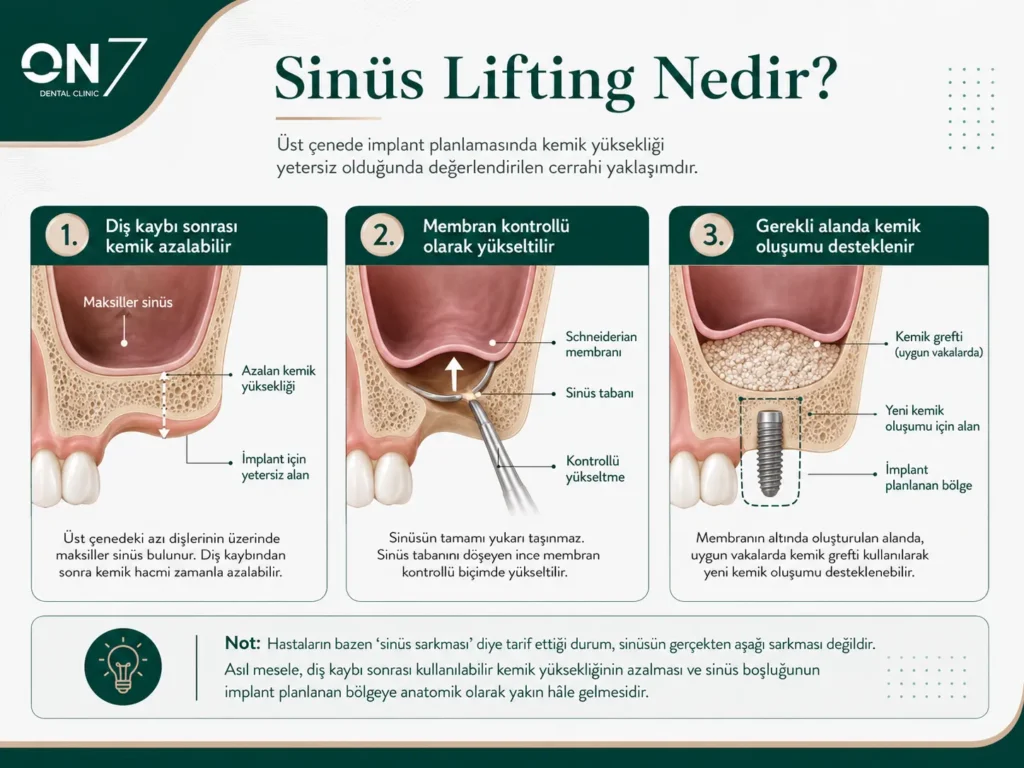
Directly above the premolars and molars in the upper jaw lie physiological air cavities known as the maxillary sinuses. Following tooth loss in this region, the alveolar jawbone can undergo volumetric resorption over time. Consequently, the distance between the sinus floor and the crest of the intraoral bone can become insufficient to support a dental implant.
During a sinus lift procedure, the entire sinus is not moved upward. Instead, the thin Schneiderian membrane lining the floor of the maxillary sinus is elevated in a controlled manner. In suitable cases, a bone graft is placed into the space created beneath the membrane to facilitate and support new bone regeneration.
What patients occasionally describe as “sinus sagging” should not be understood as the sinus physically dropping down. The underlying reality is simply a reduction in usable vertical bone height following tooth loss, which brings the physiological sinus cavity into closer anatomical proximity to the planned implant site.
Why Is There Insufficient Bone in the Posterior Maxilla?
Following tooth extraction, the jawbone does not maintain its original volume. The body physiologically remodels the bone that no longer supports tooth roots, leading to localized volumetric loss. In the posterior upper jaw, when this resorption is compounded by maxillary sinus anatomy (and progressive sinus pneumatization), the vertical bone height required to place standard-length implants safely is significantly reduced.
Particularly when years have passed since tooth extraction, patients often face a clinical scenario described as “very little bone for the implant fixture to engage.” The goal is not merely fitting an implant into bone; the fixture must achieve adequate primary stability at insertion and subsequently establish healthy, biological osseointegration.
Clinical studies demonstrate that sinus floor elevation techniques can predictably enable successful implant therapy in posterior maxillary regions with low residual bone height.
If You Were Told "Your Bone Has Resorbed, Implants Are Impossible," Are There Other Options?
Bone deficiency does not automatically render dental implants impossible. However, not every bone deficiency mandates a sinus lift either. The first step is determining the exact location, volume, and quality of the deficiency.
Consider a representative clinical scenario: a patient who lost posterior teeth over a decade ago arrives fatigued from using removable dentures, believing fixed teeth are no longer an option because they were previously told “your bone is too thin.”
When the posterior maxilla is evaluated via 3D CBCT imaging, sufficient bone volume can be reconstructed in select patients using sinus floor elevation combined with a bone graft. Once biological healing is complete and the implants have fully osseointegrated, fixed full-function prostheses become entirely achievable.
This is not a blanket guarantee of success. Every patient’s anatomical structure is unique; however, “deficient bone” and “implants are impossible” are not synonymous.
Is a Sinus Lift Necessary for Every Bone Deficiency?
No. Clarifying this distinction is vital to prevent patients from experiencing unnecessary apprehension about extensive surgery.
In some cases, residual bone volume is already adequate for implant placement.In others, short implant alternatives may be evaluated.For certain anatomical presentations, localized guided bone regeneration (GBR) or alternative implant angulations/designs may represent a more conservative and appropriate approach.
The indication for a sinus lift is determined by collectively evaluating the planned 3D position of the implant, residual bone height and width, definitive prosthetic goals, sinus internal anatomy, and the required vertical bone gain. A sinus lift is never performed simply because a sinus cavity is visible on a scan.
Is Pain Felt During Sinus Lift Surgery at Our Ataşehir Clinic?
When profound local anesthesia is established, sharp surgical pain is not expected during the operation. However, an essential distinction must be understood: feeling no pain does not mean feeling zero sensation.
During surgery, you may perceive light pressure, pushing, vibrations, or tactile touch. In particular, noticing the operation of surgical instruments or localized pressure during osteotomy preparation is entirely normal.
In classic crestal (closed) sinus lift protocols utilizing surgical osteotomes, a tapping sensation may be felt. Clinical literature indicates that newer transcrestal approaches have been developed using specialized instruments to minimize this mechanical sensation and maximize patient comfort.
If what you experience turns into sharp discomfort, you should immediately inform your clinician. You are never expected to endure pain during surgery.
What Can You Expect During the First 3 Days After a Sinus Lift?
This is precisely what patients are looking for when searching “what is the recovery like after a sinus lift?” Beyond technical surgical explanations, patients primarily want to know how they will feel the next morning.
Day 1: Mild to moderate soreness, a sensation of fullness in the cheek, and localized tension around the surgical site may occur. As local anesthesia subsides, tenderness around the surgical site is normal.
Days 2 and 3: Post-operative swelling typically peaks and becomes slightly more noticeable than on the first day. Some patients may also develop minor facial bruising (ecchymosis) on the cheek. This is a standard physiological response and does not indicate a surgical complication.
The critical metric is the trajectory of recovery. Symptoms are expected to plateau and progressively subside after the third day; any symptoms that escalate or worsen over subsequent days require clinical evaluation.