
Can Dental Implants Be Placed at a Young Age?
When you lose a tooth at a young age, have an extraction due to dental trauma, or are born with a congenitally missing tooth, one of the first questions that comes to mind is: “Can dental implants be placed at a young age?”
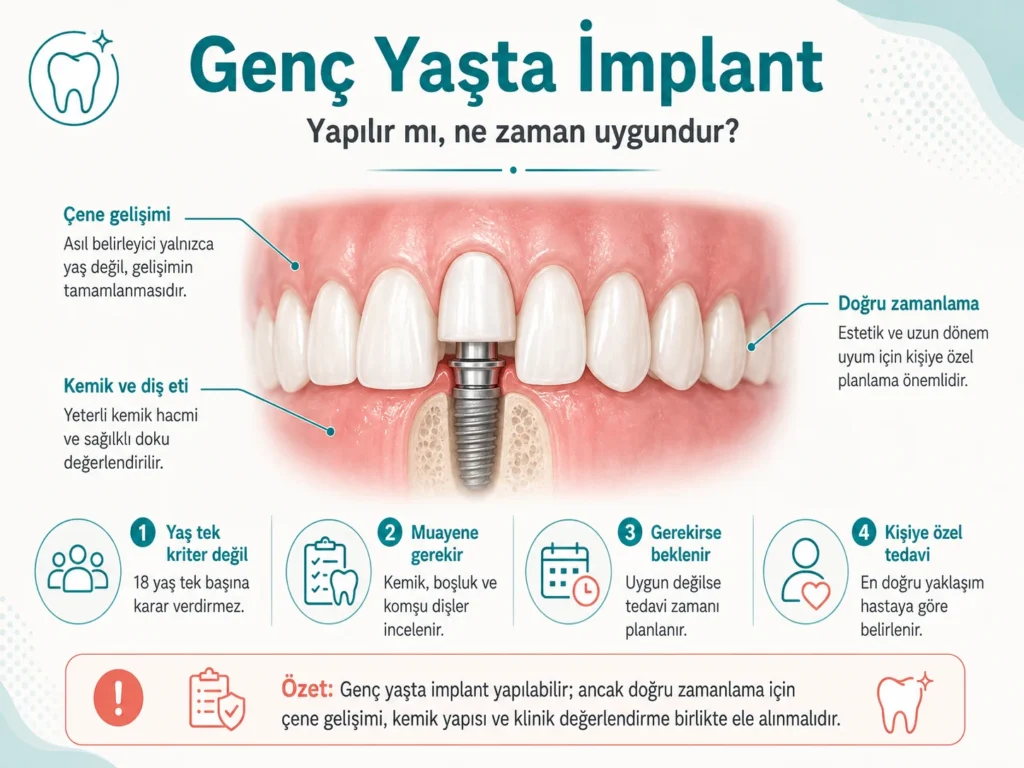
In most cases, the answer is yes, dental implants can be performed at a young age. However, when deciding on implant treatment, it is misleading to look solely at a person’s chronological age. Especially during adolescence and early adulthood, the most decisive factor determining the timing of implant therapy is whether jaw and facial growth is fully complete.
For this reason, relying on a single static number as an “implant age limit” can be deceptive. Turning 18 does not automatically make someone an eligible candidate for dental implants, nor does being under 18 completely rule out implant therapy in every specific, complex situation.
Once a dental implant integrates with the jawbone, it does not move or erupt alongside adjacent natural teeth during ongoing growth and skeletal remodeling. While jaw development continues, surrounding natural teeth and bone structures dynamically change their spatial positions. The implant, however, remains largely ankylosed and fixed in place. Consequently, implants placed while growth is still underway can lead to height discrepancies, infraocclusion, aesthetic asymmetries, or occlusal disharmony in later years. Systematic reviews on growing patients consistently report infraocclusion—especially in the maxilla (upper jaw)—as one of the most critical long-term complications.
Therefore, the question “Can dental implants be placed at a young age?” is never determined by a birthdate alone.
The core question that must be clinically evaluated is:
Not “How old are you?”, but rather “Has your jaw and facial development matured sufficiently for implant therapy?”
Can Dental Implants Be Placed at a Young Age?
Yes, dental implants can be placed at a young age. However, when planning implant therapy in young patients, chronological age must be comprehensively evaluated alongside jaw development, bone volume, gingival health, the specific site of the missing tooth, adjacent tooth positioning, and any ongoing orthodontic needs.
Especially for young patients with a single missing tooth, clinical guidelines strongly recommend waiting until facial and jaw development is largely complete.
The American Academy of Implant Dentistry notes that implant therapy can generally be evaluated once adolescent facial growth has finished—typically occurring around age 16 in females and age 18 in males. However, these milestones should never be treated as rigid age limits, as biological growth patterns vary significantly from person to person.
Therefore, prior to confirming an implant in a young patient, skeletal maturity must be assessed with equal weight to age.
What Is the Minimum Age for Dental Implants?
“At what age can you get dental implants?” and “How old do you need to be for an implant?” remain among the most frequent concerns raised by young patients and parents.
In implant dentistry, there is no universally defined, rigid minimum age.
Generally, the following factors are far more decisive than chronological age in determining treatment timing:
- Full maturation of jaw and facial growth
- Evaluation of permanent dentition status
- Sufficient bone volume (height and width) at the target site
- Root development and angulation of adjacent teeth
- Healthy, stable peri-implant soft tissues
- Interdisciplinary alignment with orthodontic treatment needs
Consider two different 18-year-old patients:
In one patient, facial and jaw development may be fully stabilized, and the edentulous site is completely ready for implant placement. In the other 18-year-old, skeletal growth may still be active, orthodontic alignment may be ongoing, or sufficient bone volume may not yet be present.
Therefore, concluding:
“I just turned 18, so I can immediately get an implant.”
is clinically inaccurate. Current literature emphasizes that dental and skeletal maturity—not the birth certificate—must guide the surgical timeline.
Is There an Age Limit for Dental Implants?
The concept of an “implant age limit” is one of the most widely misunderstood topics in adolescent and young adult dentistry.
Online sources frequently state rigid rules such as “implants can only be done after age 18.” While age 18 serves as a practical general baseline, it is by no means an absolute biological threshold.
Jaw development varies widely across individuals. While some complete their craniofacial growth relatively early, others experience continued growth well into their early twenties.
Therefore, clinical diagnostic planning should replace the question:
“Is the patient over 18?”
with the more scientifically grounded question:
“Has skeletal and dentoalveolar growth sufficiently matured?”
Furthermore, modern literature demonstrates that subtle craniofacial and dentoalveolar changes can continue even after traditional skeletal maturity is reached. Thus, no single age represents an absolute guarantee against minor long-term positional shifts.
Why Must Jaw Development and Implant Treatment Be Evaluated Together?
In young adult implantology, jaw growth is the most critical prognostic parameter.
Natural teeth adapt continuously alongside surrounding alveolar bone and soft tissue changes during facial maturation. In contrast, once a dental implant osseointegrates with the jawbone, it behaves like an ankylosed tooth and does not adapt, erupt, or move with adjacent bone remodeling.
Think of an implant as a structure anchored permanently at a fixed spatial coordinate.
As surrounding natural teeth continue their physiological vertical and horizontal migration, the implant remains immobile. Over several years, this discrepancy can cause a visible height difference between the implant porcelain restoration and neighboring natural teeth.
This divergence is especially prominent and aesthetically compromising in the upper anterior (aesthetic smile) zone.
Therefore, planning implants in young adults is never just about:
“Will the implant successfully integrate with the bone?”
It requires addressing the essential long-term question:
“How will this implant relate to the adjacent natural teeth 5, 10, or 20 years down the line?”
What Happens If an Implant Is Placed Too Early?
Alongside whether implants can be placed at a young age, patients frequently ask about the clinical consequences of premature placement.
If an implant is placed before jaw and dentoalveolar growth is complete, the surrounding natural teeth and alveolar bone will continue to develop while the implant remains locked in its initial position.
Over time, this can lead to:
- The implant restoration appearing progressively shorter than adjacent natural teeth
- The implant crown remaining submerged (infrapositioned)
- Discrepancies and asymmetry in gingival margins (scalloping differences)
- Altered vertical relationships with adjacent teeth
- Unfavorable bite alignment and occlusal interference
- Compromised anterior smile aesthetics
- The eventual necessity to remake or modify the prosthetic crown
- The most recognized manifestation of these issues is infraocclusion.
Infraocclusion occurs when an implant-supported restoration ends up positioned apical to the occlusal plane relative to surrounding natural teeth over time. Because implants cannot adapt to ongoing dentoalveolar remodeling, premature placement in growing patients is the primary cause of this complication.
Hence, adolescent implant planning must look beyond immediate surgical success to ensure predictable, long-term aesthetic and functional stability.
Can You Get an Implant at 18?
Yes, you can.
However, turning 18 alone is not sufficient clinical criteria for implant placement.
When considering implant therapy for an 18-year-old patient, clinicians must comprehensively assess:
- Craniofacial and jaw maturity
- Bone architecture and available volume
- Bone width and height at the implant site
- Gingival and periodontal health
- Root positions and angulation of adjacent teeth
- Occlusal and bite relationships
- Potential orthodontic requirements
If jaw and facial development has stabilized and local anatomical conditions are favorable, a dental implant is an excellent treatment choice at age 18. If clinical evaluation suggests active growth is still ongoing, postponing permanent implant placement remains the safer clinical protocol.
In short: Age 18 is not an automatic green light for implant surgery.
Can You Get an Implant Under 18?
The approach to placing dental implants under age 18 differs significantly between standard single-tooth cases and specialized medical conditions.
For adolescents with a single missing tooth and ongoing jaw growth, the standard protocol is to wait until skeletal growth has fully ceased.
However, there is no absolute ban prohibiting implants in every patient under 18. Under specialized clinical circumstances, early implant placement may be indicated, including:
- Severe congenital tooth agenesis (oligodontia)
- Ectodermal dysplasia
- Severe dentofacial trauma
- Specific craniofacial developmental anomalies
- Extensive multi-tooth absences severely compromising function and nutrition
- Conditions severely impacting a young patient’s quality of life and psychosocial development
Nevertheless, implants placed during active growth periods cannot be managed like standard adult procedures. Scientific consensus dictates that implant usage in developing jaws should be strictly limited to selected complex cases, with meticulous long-term monitoring of the implants and transitional prostheses until skeletal growth is finalized.
Thus, the right clinical attitude is neither:
“They are too young; it is absolutely impossible.”
nor:
“There is a missing tooth; let’s place an implant immediately.”
Every case demands personalized, evidence-based diagnostic evaluation.
Can You Get an Implant at 20?
Yes. For most young adults, age 20 is a very suitable age for dental implant placement.
If jaw and facial growth is complete, adequate bone volume exists at the site, gum tissues are healthy, and no contradictory pathologies exist, dental implants can be safely placed at age 20. The same applies to patients aged 19, 21, or 22.
Here, the primary determinant is implant candidacy and skeletal stability, not age itself.
A comprehensive implant examination addresses:
- Is jaw and facial growth stabilized?
- Is there sufficient bone quantity at the edentulous site?
- Are bone width and height adequate for optimal 3D implant positioning?
- Are adjacent tooth roots positioned safely apart?
- Is there adequate mesiodistal space between crowns?
- Are periodontal tissues healthy and free of active inflammation?
- Is active infection or periodontal disease present?
- Is interdisciplinary orthodontic treatment required first?
Based on these findings, the clinician will recommend proceeding with immediate placement, temporizing the area, or pursuing alternative restorative pathways.
How Do Dentists Determine If Jaw Growth Is Complete in Young Adults?
Determining whether jaw growth is fully finalized cannot be achieved simply by looking at a patient’s age.
A thorough dental and orthodontic evaluation integrates:
- Chronological age and medical growth history
- Clinical extraoral and intraoral findings
- Stage of dental development and occlusion
- Serial orthodontic records and dental casts
- Craniofacial proportion assessments
- Targeted radiographic imaging (such as serial cephalometric tracings or hand-wrist radiographs when indicated)
Consultation with an orthodontist is frequently incorporated into the treatment planning phase.
The underlying principle remains straightforward: in young adult implantology, asking “How old are you?” is never sufficient. In cases where growth cessation is uncertain, precision in timing safeguards long-term smile aesthetics.
Can You Get an Anterior (Front Tooth) Implant at a Young Age?
Yes, front teeth can be replaced with implants at a young age. However, anterior implants demand a far higher level of aesthetic precision than posterior (back tooth) restorations.
In the upper aesthetic zone, the following parameters directly dictate the final aesthetic outcome:
- Gingival margin levels and symmetrical festooning
- Smile line (high vs. low lip line)
- Incisal edge positioning of adjacent natural teeth
- Precise three-dimensional (3D) implant placement
- Labial bone thickness and crestal architecture
- Crown-to-tooth proportions
- Emergence profile and anatomical contour of the implant crown
- If a young patient is undergoing even subtle dentoalveolar growth, the implant will remain stationary while adjacent natural teeth continue their slow vertical drift.
When planning front tooth implants in young adults, the focus must extend beyond the immediate aesthetic result to long-term tissue stability. Patients with a high smile line reveal their gingival architecture during smiling, making even minor millimeter discrepancies immediately visible.
Therefore, a simplistic approach such as:
“There is enough bone, so we can place the front implant right away.”
is inadequate for anterior aesthetic success.
Should You Wait for an Implant If You Lose a Tooth at a Young Age?
Tooth loss in young adults most commonly occurs secondary to:
- Sports-related injuries
- Accidental falls
- Road traffic accidents
- Root fractures
- Extensive caries or endodontic failures
- Congenital tooth agenesis
If a patient is not yet biologically ready for a definitive dental implant, this does not mean the space should be left unmanaged for years.
Depending on the clinical presentation, various temporary aesthetic and functional solutions are utilized, such as:
- Removable aesthetic retainers (e.g., Essix appliances with prosthetic teeth)
- Resin-bonded adhesive restorations (Maryland bridges)
- Orthodontic space maintainers
- Customized provisional restorations
The goal here is not merely cosmetic coverage. The essential clinical objective is:
To preserve the existing bone volume, soft tissue contours, and interdental spacing in prime condition for future permanent implant placement.
Leaving a gap unmanaged can cause adjacent teeth to tip, opposing teeth to over-erupt, and alveolar bone to resorb. Early consultation ensures that proactive space-maintenance protocols begin immediately.
Can Dental Implants Be Placed After Dental Trauma in Youth?
Front teeth are particularly vulnerable to traumatic dental injuries during active childhood and youth. Sports collisions, falls, or direct facial impacts can render a permanent tooth non-restorable.
Whether an implant can be placed immediately following trauma depends on the patient’s skeletal maturity and local tissue conditions.
If jaw growth is complete, implant planning can begin. If growth is still active, permanent implant surgery is postponed while transitional aesthetic solutions preserve the site.
Additionally, trauma often damages not only the tooth but also the surrounding alveolar bone plate and soft tissue envelope. A comprehensive assessment must evaluate whether localized bone grafting or soft tissue augmentation will be required to restore the ideal foundation for an implant.
Can Implants Be Used for Congenitally Missing Teeth?
The congenital absence of permanent teeth (hypodontia or agenesis)—most frequently affecting maxillary lateral incisors and second premolars—is a common condition.
In these patients, dental implants represent a gold-standard modality to replace the missing dentition without altering healthy neighboring teeth.
However, planning implants for congenitally missing teeth requires evaluating:
- The patient’s growth and skeletal maturation stage
- Craniofacial development
- Local bone volume and ridge width at the edentulous site
- Intercoronal and interradicular spacing between adjacent teeth
- Angulation of adjacent roots
- Comprehensive orthodontic alignment requirements
In congenital agenesis, the localized alveolar bone ridge is frequently narrow due to the absence of natural tooth eruption. Consequently, young patients with missing teeth often require precise 3D radiographic assessment and localized ridge enhancement to establish adequate bone support for the implant.
Can Bone Deficiency Occur in Young Patients?
Yes. Being young does not automatically guarantee adequate bone volume for implant placement.
Several factors can compromise alveolar bone volume at a young age:
- Prolonged edentulous periods following early tooth loss
- Traumatic bone loss sustained during an injury
- Congenital tooth absence (hypodontia)
- Localized periapical infections or cysts
- Previous traumatic extractions or surgical interventions
Implant success depends not only on bone height, but equally on bone width and adequate distance from surrounding anatomical structures (such as the inferior alveolar nerve or maxillary sinus). When necessary, advanced bone grafting, guided bone regeneration (GBR), or sinus lift procedures can be performed prior to or simultaneously with implant placement.
Can Implants Be Placed Before Orthodontic Treatment Is Finished?
Coordinating orthodontic therapy with implant planning is critical in young patients.
Orthodontic mechanics intentionally move natural teeth through alveolar bone. In contrast, an osseointegrated dental implant is fused to bone and cannot be moved with orthodontic forces.
Prior to implant surgery, orthodontics is frequently used to:
- Create adequate space for the future prosthetic crown
- Diverge and parallel adjacent tooth roots
- Correct occlusal interferences and establish a stable bite
- Align the dental midline and arch form
In most cases, orthodontic alignment is completed first, followed by implant placement. In select cases, an interdisciplinary approach may determine that orthodontically closing the space is preferable to implant placement.
The optimal treatment strategy must always be formulated collaboratively between the orthodontist and the implant specialist.
What Are the Advantages of Dental Implants at a Young Age?
When performed on the right candidate, at the correct biological time, and with meticulous precision, dental implants offer distinct advantages:
- Preservation of Adjacent Teeth: Unlike traditional dental bridges, implants do not require shaving down or preparing healthy neighboring teeth for support.
- Bone Preservation: Implants provide functional stimulation to alveolar bone, helping prevent the progressive bone resorption that follows tooth loss.
- Natural Function & Aesthetics: Fixed implant crowns restore optimal chewing function, speech clarity, and lifelike smile aesthetics.
- Longevity: With proper maintenance, high-quality dental implants offer exceptional clinical longevity.
However, young age alone does not guarantee success. Long-term prognosis depends on:
- Precise 3D surgical positioning
- Adequate bone and keratinized gingiva
- Rigorous daily oral hygiene
- Routine clinical maintenance and check-ups
- Avoidance of risk factors such as smoking
- Biomechanically sound prosthetic design
What Is Evaluated Before Placing an Implant in a Young Patient?
Comprehensive clinical evaluation covers far more than just the gap left by the missing tooth:
- Craniofacial and jaw developmental stage
- Chronological age vs. biological skeletal maturity
- Anatomic location of the edentulous site
- Bone volume, density, and 3D architecture
- Periodontal and soft tissue health
- Health and stability of adjacent teeth
- Angulation and clearance of adjacent roots
- Available mesiodistal and interocclusal space
- Dynamic and static bite relationships
- Orthodontic alignment and space maintenance needs
- Oral hygiene compliance
- General medical health and systemic conditions
- History of smoking or tobacco use
- Traumatic injury history
- Congenital dental anomalies
- Long-term aesthetic and functional expectations
Following this interdisciplinary assessment, the surgical team determines whether to proceed immediately, temporize the site, or select an alternative treatment pathway.
How to Determine the Right Time for an Implant at a Young Age?
The optimal time for implant therapy cannot be determined by a single date on a calendar.
Implant timing is strictly personalized. While one patient may be fully eligible around age 18, another may require waiting until age 20 or 21 to ensure complete skeletal stabilization.
The clinical equation must always combine:
This approach is especially vital in the anterior aesthetic zone, where an implant must deliver not just immediate tooth replacement, but lasting aesthetic harmony for decades to come.
Frequently Asked Questions About Implants at a Young Age
How long does implant treatment take in young patients?
Treatment duration depends on bone quality, the implant site, and whether ancillary procedures like bone grafting are required. Osseointegration typically requires an initial healing period of 2 to 4 months. The precise timeline is established following your clinical and 3D radiological examination.
How is the missing tooth space protected before an implant can be placed?
If permanent implant placement must be postponed, leaving the space unmanaged is ill-advised. Bonded resin retainers (Maryland bridges), clear aligners with aesthetic pontics, or custom space maintainers are utilized to prevent adjacent teeth from tilting and maintain tissue architecture.
Is a 3D Dental Tomography (CBCT) required for young patients?
When detailed assessment of 3D bone volume, ridge thickness, root proximity, and vital anatomical structures is needed, low-dose Cone Beam Computed Tomography (CBCT) provides invaluable diagnostic accuracy for precision planning.
Is bone grafting needed for young patients?
Youth does not preclude localized bone deficiency. Following trauma, long-standing missing teeth, or congenital agenesis, bone volume may be insufficient. In such cases, bone grafting or guided bone regeneration is routinely performed before or during implant placement.
Can the missing space simply be left empty until implant age?
Leaving the gap unmanaged is generally inadvisable. In young patients, adjacent teeth rapidly shift, tilt into the gap, and opposing teeth over-erupt, leading to occlusal collapse and bone loss. Active space preservation is essential.
Will an implant placed at a young age last a lifetime?
While dental implants boast very high success rates exceeding 95–98%, no medical device carries an unconditional guarantee. Long-term survival depends on daily oral hygiene, regular professional cleanings, non-smoking habits, peri-implant tissue health, and balanced occlusal forces.
Is an implant or a dental bridge better for a young patient?
For a single missing tooth, a dental implant is generally preferred because it completely preserves the healthy adjacent teeth without requiring irreversible tooth reduction. However, specific anatomical or orthodontic factors may indicate alternative treatments for select individuals.
Can young athletes who play sports get dental implants?
Engaging in sports does not prevent implant treatment. However, in contact sports, the risk of facial trauma must be managed. During the surgical healing period, athletic activity should follow the clinician’s guidance, and custom-fitted athletic mouthguards are strongly advised.
Can orthodontic treatment be done after getting an implant?
Orthodontic treatment can be performed, but the implant cannot be moved because it is fused to bone. Therefore, when both treatments are needed, orthodontic tooth alignment is almost always completed before the implant is surgically placed.
Are regular dental check-ups necessary after young adult implant treatment?
Yes. To ensure decades of trouble-free function, routine clinical check-ups every 6 months are vital to monitor peri-implant bone levels, gingival health, prosthetic screw torque, and occlusal harmony.
Schedule Your Young Adult Implant Consultation at ON7 Dental Clinic!
Whether you are eligible for dental implants, whether your jaw development is complete, or which treatment timeline is optimal for your smile are questions that require specialized clinical evaluation. At ON7 Dental Clinic, we combine advanced digital imaging, specialized surgical expertise, and personalized aesthetic planning to deliver lasting, confident smiles.
To learn more about your individualized treatment plan and check your implant eligibility, contact our team today.
Contact Us!
Phone: +90 533 456 66 17
Email: hello@on7clinic.com
Address: Metropol İstanbul, Atatürk Mah. A3 Blok No:17 Kat:0, 34758 Ataşehir / İstanbul

ON7 Dental Clinic Ataşehir’de modern diş hekimliği teknolojilerini ve uzman diş hekimi kadromuzla hastalarımıza güvenli, konforlu ve kaliteli bir tedavi süreci sunuyoruz
Tedaviniz İçin İlgili Hekimlerimiz
Tedavi seçenekleri ve size uygun planlama hakkında bilgi almak için ilgili hekimlerimizi inceleyebilir veya kliniğimizle iletişime geçebilirsiniz.